
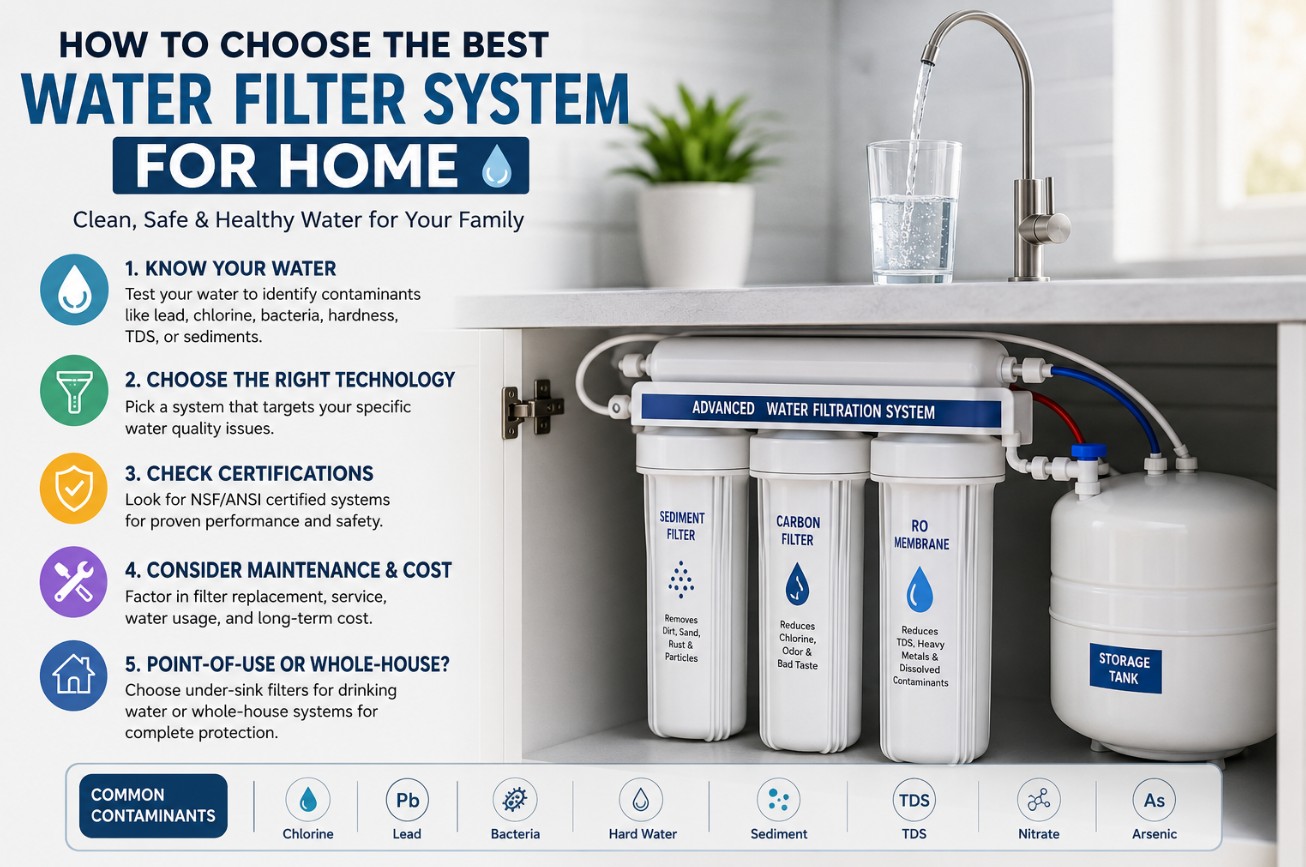
Choosing the right water filter system for home can feel confusing because there are so many products promising cleaner, safer, and better-tasting water. Some systems use activated carbon, while others rely on reverse osmosis, ultraviolet light, sediment filtration, or a combination of several technologies. The important thing to understand is that more filtration stages do not automatically mean better water.
The best system is the one that matches your actual water quality and household needs. A family dealing with chlorine taste may need something very different from a home with hard well water or high dissolved solids. Instead of focusing only on brand names or marketing claims, it is better to look at the contaminants you want to reduce, the filter’s independent certifications, maintenance requirements, water usage, and long-term operating cost.
What Should You Look for in a Water Filter System for Home?
Start by identifying what you want the filtration system to accomplish. Some people simply want better-tasting drinking water, while others are concerned about sediment, lead, arsenic, bacteria, high mineral content, or other substances. Activated carbon filters, for example, are commonly used to improve taste and reduce chlorine, but they should not automatically be expected to remove every dissolved contaminant or microorganism.
You should also consider where you need filtered water. A point-of-use system treats water at one location, such as the kitchen sink, and is often practical when the main goal is cleaner water for drinking and cooking. A point-of-entry or whole-house system treats water as it enters the property, making it more appropriate when water quality affects showers, appliances, plumbing, laundry, and multiple taps.
Flow rate and household demand matter as well. A small under-sink filter may work well for one kitchen, but it is not designed to supply an entire property. Whole-house systems must be sized correctly so that they can handle normal peak demand without causing a noticeable pressure drop.
Which Type of Home Water Filter Is Right for Your Water?
Activated carbon is one of the most common filtration methods in homes. It is particularly useful for reducing chlorine-related taste and odor and may also reduce certain organic chemicals, depending on the filter and its certification. Carbon filters are available in pitchers, refrigerator filters, faucet-mounted units, under-sink systems, and larger whole-house configurations.
Reverse osmosis, or RO, provides broader treatment for many dissolved substances. Depending on the system, it may reduce contaminants such as lead, arsenic, nitrate, fluoride, sodium, and dissolved salts. RO systems use a membrane to separate treated water from a concentrated waste stream, so homeowners should also consider water efficiency when comparing models.
Other technologies address different problems. Sediment filters capture dirt, rust, sand, and suspended particles. Ultraviolet systems use UV light to inactivate microorganisms but do not remove dissolved salts or chemicals. Water softeners mainly address hardness caused by calcium and magnesium, helping reduce scale buildup in pipes, fixtures, and appliances.
A home may sometimes need more than one technology. For example, sediment filtration can protect downstream equipment, activated carbon may address taste and chlorine, and RO may be used specifically for drinking water. The right combination should be based on actual water conditions rather than the number of stages advertised on the product box.
Why Should You Test Your Water Before Choosing a Filter?
Water can look clear and still contain substances you cannot see, smell, or taste. That is why testing is one of the most useful steps before spending money on a filtration system. If your home is connected to a municipal water supply, you may be able to review your local water quality report. Private well owners generally need to arrange their own testing.
Testing helps determine whether the issue involves microorganisms, hardness, dissolved minerals, heavy metals, nitrate, sediment, or other contaminants. The CDC’s guidance on choosing home water filters also recommends understanding what is in your water before selecting a treatment method. This prevents situations where someone purchases an expensive filter that does not actually address the problem.
For private wells, regular testing is especially important because groundwater quality can change over time. Local geology, agriculture, flooding, nearby industry, septic systems, and plumbing materials may all affect water quality. A qualified laboratory can provide results that make it easier to choose the appropriate treatment technology.
Once you know what needs to be reduced, compare systems based on their performance for those specific contaminants. Avoid assuming that terms such as “pure,” “advanced,” or “multi-stage” guarantee comprehensive treatment.
How Do Certifications, Maintenance, and Cost Affect Your Choice?
Independent certification is one of the best ways to evaluate a filter’s claims. NSF/ANSI standards are commonly used for residential water treatment equipment. For example, NSF/ANSI 42 generally covers aesthetic effects such as chlorine taste and odor, while NSF/ANSI 53 addresses certain contaminants with health effects. NSF/ANSI 58 applies to reverse osmosis systems, and NSF/ANSI 55 relates to ultraviolet treatment.
However, certification to a standard does not mean a filter removes every contaminant covered by that standard. Always check the exact performance claims for the specific model. If lead is your concern, for example, confirm that the product is certified specifically for lead reduction rather than simply displaying a general certification logo.
Maintenance also plays a major role in performance. Filters have limited capacities and must be replaced according to the manufacturer’s instructions. RO membranes, UV lamps, sediment cartridges, carbon filters, and softener media all have different service requirements. A system that is ignored for years may no longer perform as intended.
When comparing prices, calculate more than the initial purchase cost. Include replacement filters, membranes, electricity, water use, professional servicing, and any plumbing modifications. A cheaper unit can become expensive if replacement cartridges are costly or difficult to obtain.
Whole-House vs. Under-Sink Water Filters: Which Is Better?
Whole-house filtration makes sense when water problems affect the entire property. Sediment, excessive chlorine, hardness, or certain source-water issues may affect showers, washing machines, water heaters, fixtures, and plumbing as well as drinking water. In these cases, treating water near the point where it enters the home can offer broader protection.
Under-sink systems are more targeted. They treat a smaller quantity of water used mainly for drinking and cooking, which can make advanced filtration such as reverse osmosis more practical and economical. There is often little reason to use highly purified RO water for flushing toilets, washing floors, or outdoor watering.
Some households benefit from combining both approaches. A whole-house sediment or carbon system may handle general water quality, while an under-sink RO unit provides more intensive treatment at the kitchen tap. Homes with hard water may also use a separate softener to protect appliances and plumbing.
Your final decision should therefore depend on where the problem occurs, how much treated water you need, and what contaminants are present. Bigger systems are not automatically better; appropriate treatment is more important than system size.
Conclusion
Choosing the best water filter system for home starts with understanding your water rather than choosing a product based on advertising. Test or review your water quality, identify the contaminants or problems that matter, and then select a technology designed to address them.
Activated carbon works well for many taste and odor concerns, RO can provide broader treatment for dissolved contaminants, UV targets microorganisms, sediment filters remove particles, and softeners address hardness. Whatever system you choose, look for relevant independent certification and factor regular maintenance into your decision. A properly matched and maintained system is far more valuable than one with unnecessary features.
FAQs
What is the best water filter system for home use?
There is no single best system for every home. The right option depends on your water source, contaminants, household size, and whether you need drinking-water filtration or whole-house treatment.
Is reverse osmosis better than a regular water filter?
RO generally removes a broader range of dissolved substances than a basic carbon filter. However, carbon filtration may be sufficient when the main concern is chlorine taste or odor.
Do whole-house water filters make drinking water safe?
It depends on the system and the contaminants present. Whole-house filtration does not automatically guarantee safe drinking water. The treatment technology must be appropriate for your water quality.
How often should home water filters be changed?
Replacement intervals vary by system, filter capacity, water quality, and usage. Follow the manufacturer’s recommended schedule and replace filters sooner if performance noticeably declines.
