
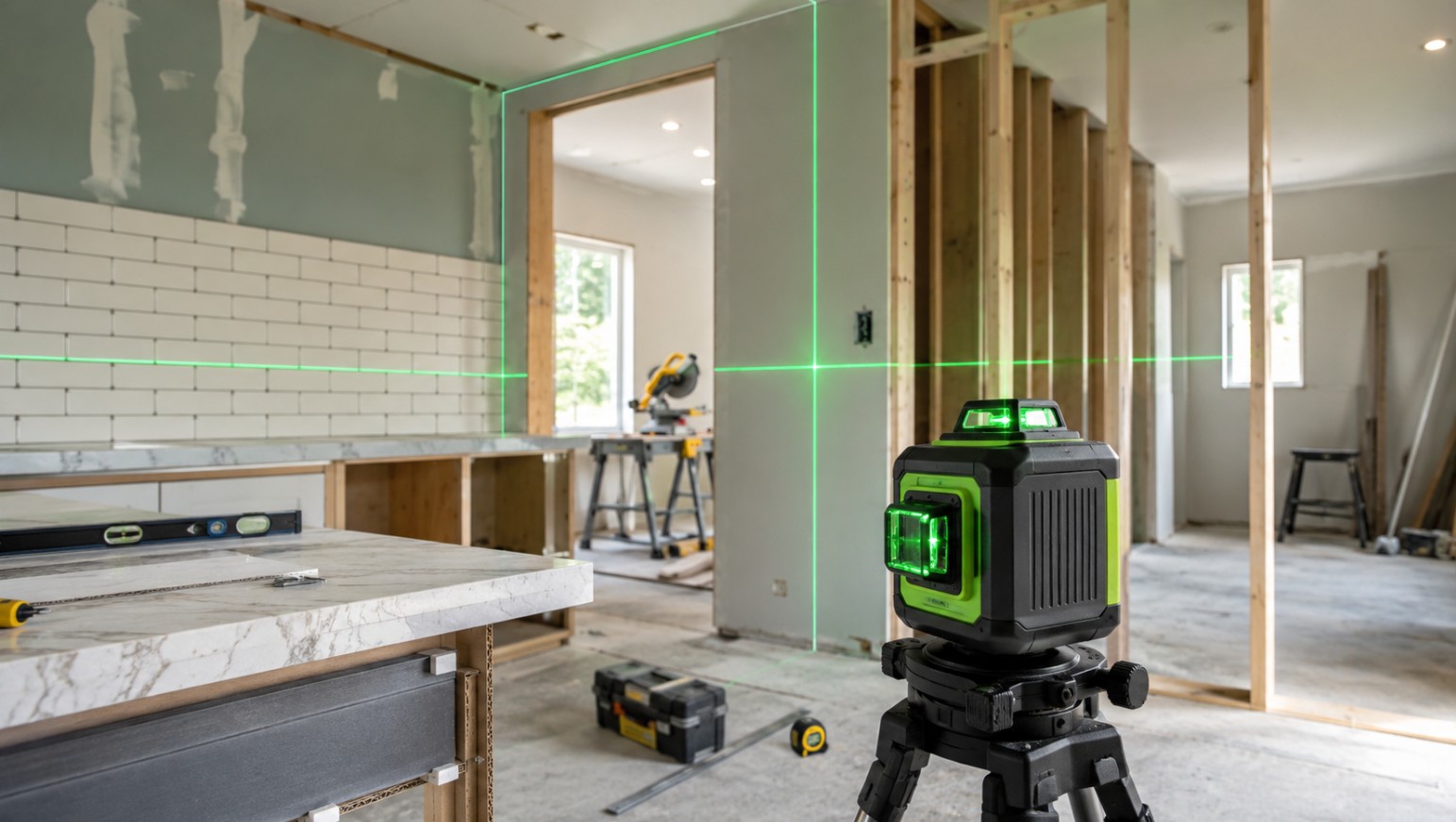
Finding the best laser level can make a noticeable difference in how accurately and efficiently you complete home improvement or construction projects. Whether you are hanging shelves, installing cabinets, laying tile, framing walls, or setting ceiling lines, a reliable laser level creates a consistent reference that is much easier to follow than repeatedly checking a traditional spirit level.
Modern laser levels range from compact cross-line tools for occasional DIY jobs to advanced 3×360-degree systems built for professional construction. Features such as self-leveling, green beams, rechargeable batteries, magnetic mounts, and detector compatibility have made these tools more practical than ever. The right choice is not necessarily the most expensive one. It is the model that matches the accuracy, range, beam configuration, and durability your work actually requires.
What Makes the Best Laser Level Worth Buying?
Accuracy should be your first consideration when comparing laser levels. A basic cross-line model can be more than adequate for hanging pictures, fitting shelves, or installing kitchen cabinets, while professional construction often requires tighter tolerances over longer distances. Manufacturers typically express accuracy as a possible variation over a set distance, such as ±1/8 inch at 30 or 33 feet. The smaller that variation, the more precisely the laser can guide your layout work.
Usability matters just as much as precision. Self-leveling is one of the most valuable features because the tool automatically corrects small positioning errors within its leveling range. A pendulum lock is also useful for protecting the internal mechanism during transport and for projecting angled lines when needed. Other practical features include magnetic mounting brackets, tripod threads, rechargeable batteries, clear battery indicators, and rugged housings that can withstand everyday jobsite use.
The type of laser projection also affects how useful the tool will be. Cross-line lasers project horizontal and vertical lines in front of the user, while 360-degree models can create a level reference around an entire room. A 3×360-degree laser adds two vertical planes, making it much easier to align walls, cabinets, doors, ceilings, and floor layouts without constantly repositioning the tool.
Best Laser Levels for DIY and Home Projects
For most homeowners, a compact green cross-line laser is usually the most practical option. The Bosch GLL50-20G is a strong example because it combines a bright green beam, self-leveling operation, compact size, and straightforward controls. It works well for common tasks such as mounting shelves, aligning pictures, installing trim, setting cabinets, or keeping tile courses straight.
DIY users who need room-wide coverage may benefit more from a 360-degree laser. The SKIL LL9322G-01 projects a 360-degree horizontal green line and is designed for larger indoor projects. It is particularly useful when you need the same level reference on multiple walls, such as when installing kitchen cabinets, chair rails, electrical outlets, or decorative wall panels.
Another option worth considering is the Huepar HM03CG, which provides three 360-degree green laser planes. Its combination of a horizontal plane and two vertical planes makes it far more flexible than a standard cross-line laser. It can be useful for more ambitious renovation projects involving floor tile, cabinetry, ceiling work, or wall layout.
For occasional household projects, however, more laser planes are not automatically better. A homeowner who mainly hangs pictures and shelves may get more value from a simple, reliable Bosch cross-line model than from a feature-heavy professional system. Choosing according to your actual workload helps avoid paying for functions you rarely use.
Best Professional Laser Levels for Construction Work
Professional users typically need more than basic cross-line functionality. Construction work often involves larger spaces, longer distances, tighter tolerances, and repeated use throughout the day. For those jobs, 3×360-degree laser levels from established tool manufacturers can offer major productivity benefits.
The DeWalt DCLE34033D1 is designed for demanding layout applications and provides three independently controlled 360-degree green laser planes. This makes it suitable for framing, commercial interior work, ceiling grid installation, cabinetry, plumbing alignment, and electrical layout. Professionals can position the tool once and establish horizontal and vertical references across a large work area.
Milwaukee’s M12 3632-21 is another professional-grade option. It combines three green 360-degree planes with a rugged housing, magnetic mounting system, long battery runtime, and compatibility with Milwaukee’s M12 battery platform. Those features are especially useful for tradespeople who already use Milwaukee cordless tools and want a laser that fits into the same battery ecosystem.
Working range is another important distinction between homeowner and professional models. Standard line lasers are generally designed for interior use, while professional lasers may support compatible receivers for much longer distances. DeWalt, for example, provides detailed specifications for its professional laser systems on its official laser level product pages, which is useful when comparing accuracy, beam configuration, battery compatibility, and detector range before buying.
For major outdoor leveling work, a rotary laser may be more appropriate than a line laser. Rotary systems are commonly used for grading, foundations, concrete work, and large construction sites because they can establish a level reference over much greater distances, especially when paired with a detector.
Green vs. Red Laser Levels: Which Is Better?
Green laser levels have become increasingly popular because the human eye generally detects green light more easily than red light. That can make a green beam easier to see across larger rooms or in brighter indoor environments. For tiling, cabinetry, framing, or renovation work where visibility matters, green is often the more convenient choice.
Red laser levels still have advantages. They are often less expensive and can perform perfectly well for shorter indoor distances. If your projects are limited to hanging artwork, fitting shelves, aligning fixtures, or completing occasional repairs, a red laser may provide everything you need without increasing your budget unnecessarily.
It is also important to understand that beam color does not determine accuracy. A green laser is not automatically more precise than a red one. Accuracy depends on the quality, calibration, and specifications of the particular tool. Always compare the manufacturer’s tolerance rather than assuming a brighter beam means a more accurate level.
Outdoor visibility is another issue. Even a strong green beam can become difficult to see in direct sunlight. For exterior work, detector compatibility is usually more useful than simply choosing a brighter laser. A compatible receiver can identify the laser plane even when the beam itself is difficult to see with the naked eye.
How to Choose the Right Laser Level for Your Needs
Start by considering the projects you complete most often. For basic DIY jobs, a self-leveling cross-line laser is usually enough. For full-room renovation, cabinets, tiling, or trim, a 360-degree model can save time because you do not need to reposition the tool every time you move to another wall.
Professional users should pay closer attention to accuracy, durability, runtime, mounting options, and receiver compatibility. A tool that is used every day needs to handle dust, knocks, transportation, and long working sessions. Battery compatibility can also be important if you already own cordless tools from DeWalt, Milwaukee, Bosch, or another major platform.
A few specifications deserve particular attention:
- Accuracy: Look for clearly stated tolerances at a specified distance.
- Range: Choose enough working distance for the spaces where you normally work.
- Beam layout: Cross-line, 360-degree, or 3×360-degree depending on the project.
- Self-leveling: Makes setup faster and reduces positioning errors.
- Mounting system: Magnetic brackets and tripod threads improve flexibility.
- Detector mode: Important for long-range or outdoor use.
- Battery life: More important for contractors than occasional DIY users.
- Durability: Look for protective housing and appropriate dust or water resistance.
Price should be considered after these requirements, not before them. A cheaper laser that lacks the range or mounting system you need may end up being frustrating, while a premium professional model may be unnecessary for occasional household work. The best value comes from matching the tool to the job.
Conclusion
The best laser level depends on how and where you intend to use it. For most homeowners and DIY users, a dependable self-leveling green cross-line model such as the Bosch GLL50-20G offers a practical balance of visibility and simplicity. Users tackling larger renovation projects may benefit from a 360-degree SKIL or 3×360-degree Huepar model.
For professional construction, tools such as the DeWalt DCLE34033D1 and Milwaukee M12 3632-21 provide greater coverage, durability, and jobsite flexibility. Rather than focusing only on brand or price, compare accuracy, range, laser configuration, mounting options, battery performance, and detector compatibility. A laser level that matches your real working conditions will usually deliver better value than one with features you do not need.
FAQs
What is the best laser level for home use?
A self-leveling green cross-line laser is usually the best choice for household projects. Models such as the Bosch GLL50-20G are suitable for shelves, pictures, cabinets, trim, and tile work.
Is a 360-degree laser level worth buying?
Yes, particularly for room-wide projects. A 360-degree laser can project a consistent level line around multiple walls, making cabinet, tile, ceiling, and trim installation easier.
Is a green laser level better than a red one?
Green beams are generally easier to see, especially in brighter indoor environments. However, beam color does not determine accuracy, and red lasers can still work well for short-distance DIY tasks.
Can laser levels be used outdoors?
Yes, but bright sunlight can make the beam difficult to see. For outdoor or long-distance work, choose a laser level that supports a compatible detector or consider a rotary laser.
