
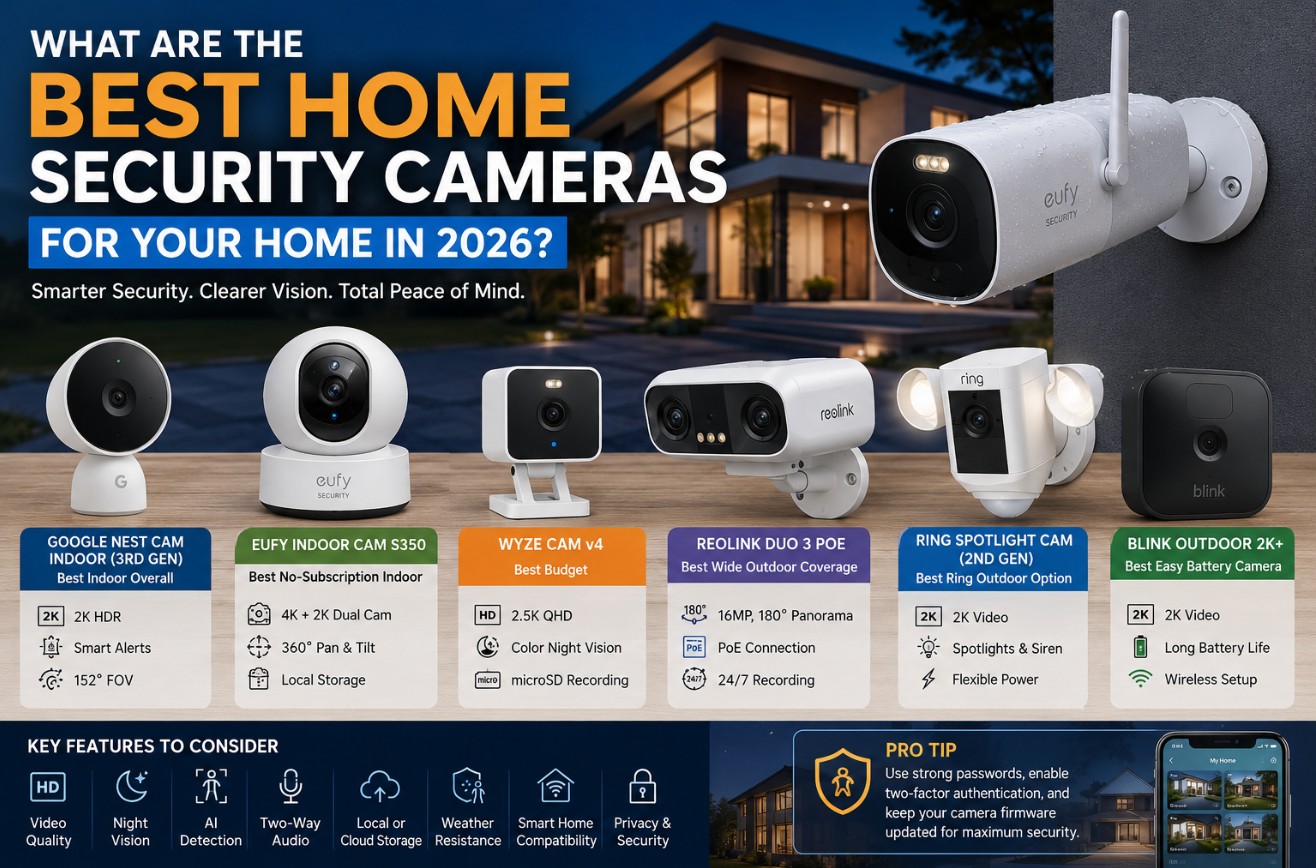
Home security cameras are more capable than ever in 2026. Many models can now identify people, vehicles, pets, and packages, record clear video after dark, and send useful alerts directly to your phone. Some cameras store footage locally, while others rely on cloud services. There are also battery-powered, wired, solar-powered, and Power over Ethernet options, so the right choice depends heavily on where and how you plan to use the camera.
Choosing the best home security cameras is therefore less about finding one universal winner and more about matching the camera to your property. A renter may prioritize simple wireless installation, while a homeowner protecting a large driveway may prefer a wired camera with continuous recording. Video quality matters, but storage, night performance, privacy controls, smart alerts, and long-term costs are equally important.
What Should You Look for in the Best Home Security Cameras?
Start with image quality, but do not focus on resolution alone. A well-designed 2K camera with strong HDR and good low-light performance can sometimes provide more useful footage than a 4K camera that struggles after sunset. For most homes, 2K or 2.5K resolution offers a practical balance between detail, storage requirements, and network usage. Higher-resolution 4K cameras can be valuable when you need to zoom into footage from a driveway, garden, or other large outdoor space.
Field of view is another important consideration. A wide-angle camera can monitor more of an entrance or yard without requiring multiple devices. Indoors, pan-and-tilt cameras can be useful because they allow a single unit to cover a much larger room. For security purposes, features such as two-way audio, activity zones, built-in sirens, spotlights, and motion-triggered recording can also make a meaningful difference.
Alert quality is just as important as video quality. A camera that sends a notification every time a tree moves can quickly become frustrating. Better cameras use smart detection to distinguish people, vehicles, pets, and other types of motion. This helps reduce unnecessary notifications and makes it easier to identify events that actually need your attention.
Which Home Security Camera Type Fits Your Property?
Battery-powered cameras are among the easiest security cameras to install. They do not require a nearby electrical outlet, so they can be mounted on exterior walls, fences, garages, or other areas where running cable would be difficult. This flexibility makes them particularly appealing to renters and people who want a straightforward DIY installation. The trade-off is that batteries eventually need charging or replacement, especially in busy areas with frequent motion.
Wired Wi-Fi cameras receive continuous power through a cable while sending video over your wireless network. Because they do not depend on batteries, they are generally better suited to areas where frequent recording is expected. Indoor cameras commonly use this design, although weather-resistant wired outdoor models are also available.
For more permanent surveillance, PoE cameras deserve consideration. Power over Ethernet delivers both data and electricity through a single Ethernet cable. PoE systems are often paired with a network video recorder, or NVR, allowing cameras to record locally around the clock. Installation takes more effort than a battery camera, but the result can be more reliable for large homes, driveways, gates, and other areas where consistent recording matters.
Are Local Storage and Subscription-Free Cameras Better?
Storage can significantly affect the long-term cost of a security system. Cloud-based cameras upload recorded clips to remote servers, making footage accessible even if someone damages or steals the camera. Cloud services can also provide extended event history and advanced AI features. The drawback is that many brands charge a monthly or annual subscription for longer recordings or more sophisticated detection tools.
Local storage avoids some of those ongoing costs. Depending on the camera, footage may be stored on a microSD card, a dedicated hub, USB storage, or an NVR. This can be attractive for homeowners who want more control over their recordings and do not want to pay a recurring fee. However, local recordings should still be protected carefully because footage stored only on the camera could be lost if the device is stolen.
There is no rule that one approach is always better. Cloud storage is convenient and provides useful off-site backup, while local storage gives users greater control and can reduce recurring expenses. Before buying, check exactly what features work without a subscription. Some cameras advertise subscription-free operation but reserve advanced detection or extended history for paying customers.
The FTC’s guidance on securing home security cameras also recommends paying close attention to how video and account information are protected. Storage should therefore be evaluated not only for convenience and price but also for privacy and account security.
How Important Are Night Vision, AI Detection, and Privacy?
Night performance is one of the most important features of an outdoor camera. Standard infrared night vision can capture useful footage in very dark conditions, although the image is usually black and white. Color night vision uses better low-light sensors, integrated lighting, or both to preserve more visual detail. A built-in spotlight can also act as a deterrent while helping the camera record clothing, vehicles, and other details in color.
Artificial intelligence has also become more useful in home surveillance. Person detection can reduce alerts triggered by leaves or shadows, while vehicle and package detection are particularly useful for driveways and front doors. Some modern cameras can recognize pets or familiar faces as well. These features are convenient, but buyers should check whether they operate locally or depend on paid cloud services.
Privacy should never be treated as an optional feature. Home cameras can record highly sensitive information, particularly when installed indoors. Use strong, unique passwords and enable two-factor authentication whenever it is available. Keep the camera firmware and mobile application updated, and avoid leaving default usernames or passwords unchanged.
It is also worth reviewing privacy zones and microphone controls. A camera pointed toward a neighboring property may create unnecessary privacy concerns. Indoors, physical privacy shutters or software privacy modes can provide additional reassurance when monitoring is not required.
Which Home Security Camera Is Best for Different Needs?
Different households benefit from different types of cameras. For general indoor monitoring, a 2K or 4K wired camera with person detection and local storage can provide excellent value. Models with pan-and-tilt functionality are particularly useful for monitoring pets, children, or large living areas because one camera can cover more of the room.
For outdoor areas, weather resistance should be a priority. Battery cameras work well when easy installation matters, while wired or PoE cameras are generally better suited to permanent surveillance. A wide-angle camera can be particularly useful for a driveway or yard because it reduces blind spots. If there is no reliable Wi-Fi connection, a cellular or 4G security camera may be more appropriate.
Popular brands such as Google Nest, Eufy, Ring, Blink, Wyze, Reolink, and TP-Link offer different strengths. Nest is well suited to Google Home users, while Ring and Blink integrate naturally with Amazon’s ecosystem. Eufy and Reolink are often attractive to people interested in local storage, and Wyze continues to offer feature-rich options at relatively accessible prices.
Rather than choosing solely by brand, compare the specific model’s features. Check whether smart detection requires a subscription, how much local storage is supported, whether outdoor models have an appropriate weather-resistance rating, and how long recordings are retained. A camera that fits your actual security needs will usually be more useful than the model with the longest specification list.
Conclusion
The best home security cameras in 2026 combine clear video, reliable alerts, strong nighttime performance, secure storage, and sensible privacy controls. The right system will depend on where you plan to install the cameras and whether you prioritize easy installation, continuous recording, local storage, or advanced smart-home features.
For simple monitoring, a battery or wired Wi-Fi camera may be enough. Larger properties may benefit more from PoE cameras and an NVR. Whatever you choose, look beyond resolution and consider storage costs, security updates, smart detection, night vision, and account protection before making a final decision.
FAQs
What resolution is best for a home security camera?
For most homes, 2K or 2.5K provides enough detail without creating excessively large video files. 4K can be useful for larger outdoor areas where digital zoom is important.
Are wireless security cameras better than wired cameras?
Wireless battery cameras are easier to install, while wired cameras usually provide more consistent power and are better suited to frequent or continuous recording.
Can home security cameras work without a subscription?
Yes. Many cameras support microSD cards, hubs, or NVR storage. However, some smart detection and cloud-history features may still require a subscription.
Where should outdoor security cameras be installed?
Common locations include the front door, driveway, back entrance, garage, and other accessible areas around the property. Position cameras high enough to discourage tampering but low enough to capture useful facial detail.
