
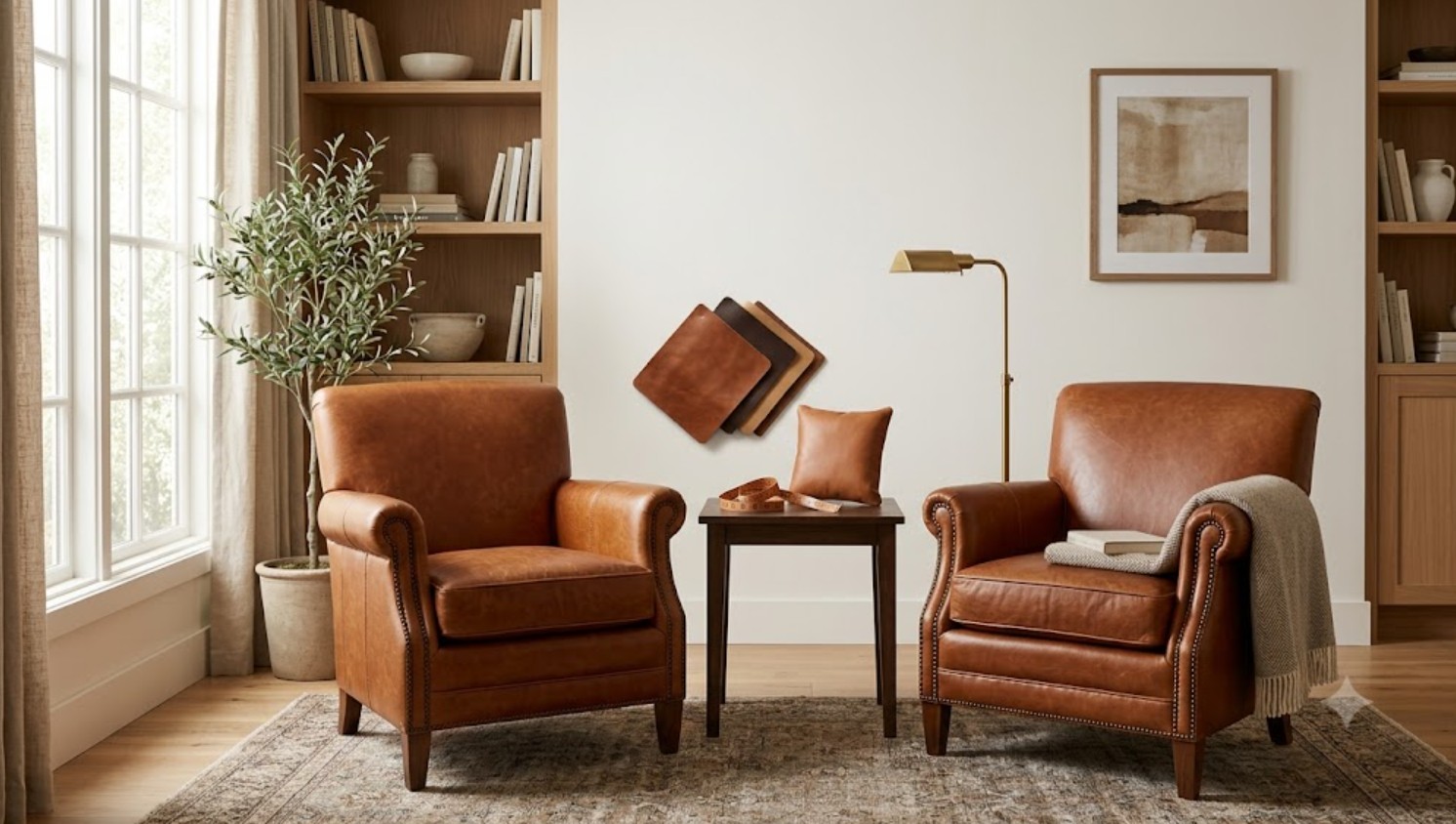
Choosing between different leather club chairs can be more difficult than it first appears. Two chairs may share the same classic shape and rich colour, yet offer very different levels of comfort, durability, and value. The leather matters, but the internal frame, seat support, cushion filling, proportions, and quality of construction are just as important.
The best chair should suit both your room and the way you plan to use it. A deep, low design may be ideal for relaxed reading, while a higher seat with firmer support may work better for everyday sitting. Looking beyond colour and appearance will help you choose a leather armchair that feels comfortable, fits your available space, and ages in a way that suits your home.
Understand the Different Leather Types and Finishes
Start by asking exactly what type of leather covers the chair. Full-grain leather retains the natural surface of the hide, including grain variation and small markings. Corrected-grain leather has been lightly buffed or treated to create a more uniform appearance. Split leather comes from a lower layer of the hide and is often coated, while bonded leather combines leather fibres with other materials. These options can look similar in photographs but may feel and wear differently.
The finish also affects everyday performance. Aniline leather has a soft, natural appearance but can absorb spills and show scratches more easily. Semi-aniline leather has a light protective coating, giving it a balance of character and practicality. Pigmented or protected leather has a stronger surface finish and is usually easier to clean. For a busy household, protected grain leather is often more practical than a delicate, untreated surface.
Do not rely on broad descriptions such as “genuine leather,” “premium leather,” or “Italian leather.” These phrases do not explain the finish, thickness, hide layer, or material used on the sides and back. Ask the retailer whether the whole chair is leather or whether synthetic material appears on less visible surfaces.
Check the Frame, Suspension, and Cushion Quality
A chair can use attractive leather and still be poorly made underneath. The frame carries the user’s weight and should feel stable when you sit down, lean back, or place light pressure on the arms. Kiln-dried hardwood is widely associated with durable furniture, although properly engineered timber can also perform well. Reinforced corners and securely joined sections are more important than vague claims about a “solid” frame.
The suspension system supports the seat cushion. Common options include sinuous springs, pocket springs, elastic webbing, and traditional hand-tied springs. No system guarantees quality by name alone because the thickness, spacing, and installation also affect performance. Test every part of the seat, including the centre, and listen for creaking or movement that could suggest weak joints or poor support.
Cushion filling determines how the chair feels and how much maintenance it requires. Foam generally provides firmer support and keeps its shape with less attention. Fibre feels softer but needs regular plumping. A foam core wrapped in fibre or feather can provide a good balance between structure and comfort. Check whether cushions are removable, reversible, or replaceable, as these features can make future care and repairs easier.
Choose the Right Size, Shape, and Comfort Level
Leather club chairs vary greatly in shape. Traditional models often have rolled arms, a deep seat, and a substantial body. Tub or barrel chairs have a curved back that flows into the arms and can work well in smaller rooms. High-back chairs provide more upper-body support, while swivel and reclining designs offer additional movement and flexibility.
Overall width does not tell you how much sitting space the chair provides. Thick rolled arms may create a large footprint but leave a relatively narrow seat. Check the usable seat width, seat depth, seat height, back angle, and arm height. A deep seat may suit someone who likes to lounge, but it can feel uncomfortable for a shorter person whose feet do not reach the floor.
Try the chair for more than a few seconds. Sit in your usual position and notice whether the back supports you naturally. Your knees should feel comfortable, the seat edge should not press sharply into your legs, and the arms should sit at a relaxed height. If you find it difficult to stand, consider a firmer cushion and a slightly higher seat.
Match the Chair to Your Home and Lifestyle
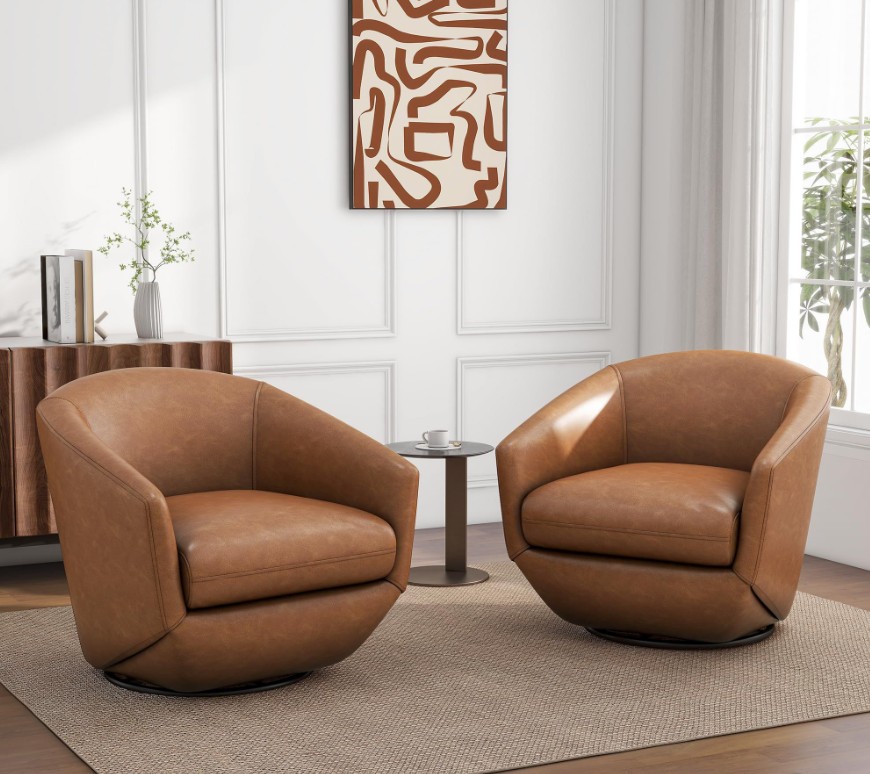
Think about how often the chair will be used and who will use it. A natural aniline finish may suit a formal study where spills are unlikely. A protected leather chair is usually more practical in a family living room, reading corner, or home with pets. Mid-tone colours can be forgiving because pale leather may show clothing-dye transfer, while very dark leather can make light scratches more visible.
Pet owners should remember that no leather is completely claw-proof. Small scratches may blend into the character of pull-up leather, but deeper damage can remain visible. Removable cushions and replaceable leather panels may therefore be more valuable than claims that a chair is “pet-friendly.” Families with children should also check whether spills can be wiped away with a manufacturer-approved cleaner.
Material sourcing may matter when comparing similar products. The official Leather Working Group certification programme assesses leather-manufacturing facilities against environmental and social criteria. Certification does not prove that the whole chair is sustainable, but it provides more useful evidence than an unsupported “eco-friendly” claim.
Measure the room and the delivery route before ordering. Mark the chair’s footprint on the floor with masking tape and leave space for doors, side tables, and walking paths. Measure entrances, corridors, stairs, landings, and lifts. Swivel and reclining models also need enough clearance to move without hitting walls or nearby furniture.
Compare Care, Warranty, and Long-Term Value
The cheapest chair is not always the best value, and the most expensive model is not automatically the best made. Compare the complete specification: leather type, finish, frame, suspension, cushion construction, stitching, dimensions, and warranty. A detailed product description is more useful than luxury language or an impressive showroom display.
Read the warranty carefully before paying. Check whether it covers the frame, springs, cushions, seams, leather surface, and any reclining or swivel mechanism. Look for exclusions involving pets, body oils, sunlight, accidental damage, or the use of unapproved cleaning products. Keep the receipt, care guide, and written product description in case you need to make a claim.
Leather care should match the specific finish. Dust the chair with a soft cloth, vacuum seams gently, and blot spills instead of rubbing them. Avoid household polish, disinfectant wipes, washing-up liquid, alcohol, and general-purpose cleaners unless the manufacturer approves them. Some leather finishes benefit from conditioning, while others can be damaged by the wrong product.
Also consider repairability. A chair with replaceable cushions, feet, panels, or mechanical parts may remain useful for longer than one with permanently fixed components. Ask whether replacement parts will be available and whether the retailer offers repair services. Long-term ownership costs can matter more than a small difference in the initial price.
Conclusion
Choosing the best leather club chairs requires more than finding the right colour or traditional shape. Start with the leather type and finish, then examine the frame, suspension, cushions, measurements, and warranty. These details will tell you far more about quality than labels such as “genuine” or “luxury.”
The right chair should support your body, fit the room, and suit your household. Protected leather may be the sensible option for frequent use, while aniline or pull-up leather may appeal to buyers who appreciate natural variation and patina. A clear specification, comfortable proportions, and reliable aftercare are the strongest signs of a worthwhile purchase.
Frequently Asked Questions
Are leather club chairs comfortable?
Yes, but comfort depends on seat depth, cushion firmness, back height, and arm position. Always check the measurements and test the chair where possible.
What type of leather is best for a club chair?
Protected or pigmented grain leather is often best for regular household use. Aniline leather offers a more natural appearance but requires greater care.
Are leather club chairs suitable for small rooms?
Compact tub or barrel-style chairs can work well in smaller spaces. Measure both the overall footprint and the usable seat width before buying.
How should you clean a leather club chair?
Dust it regularly and blot spills promptly. Use only cleaning and conditioning products approved for the chair’s specific leather finish.
