
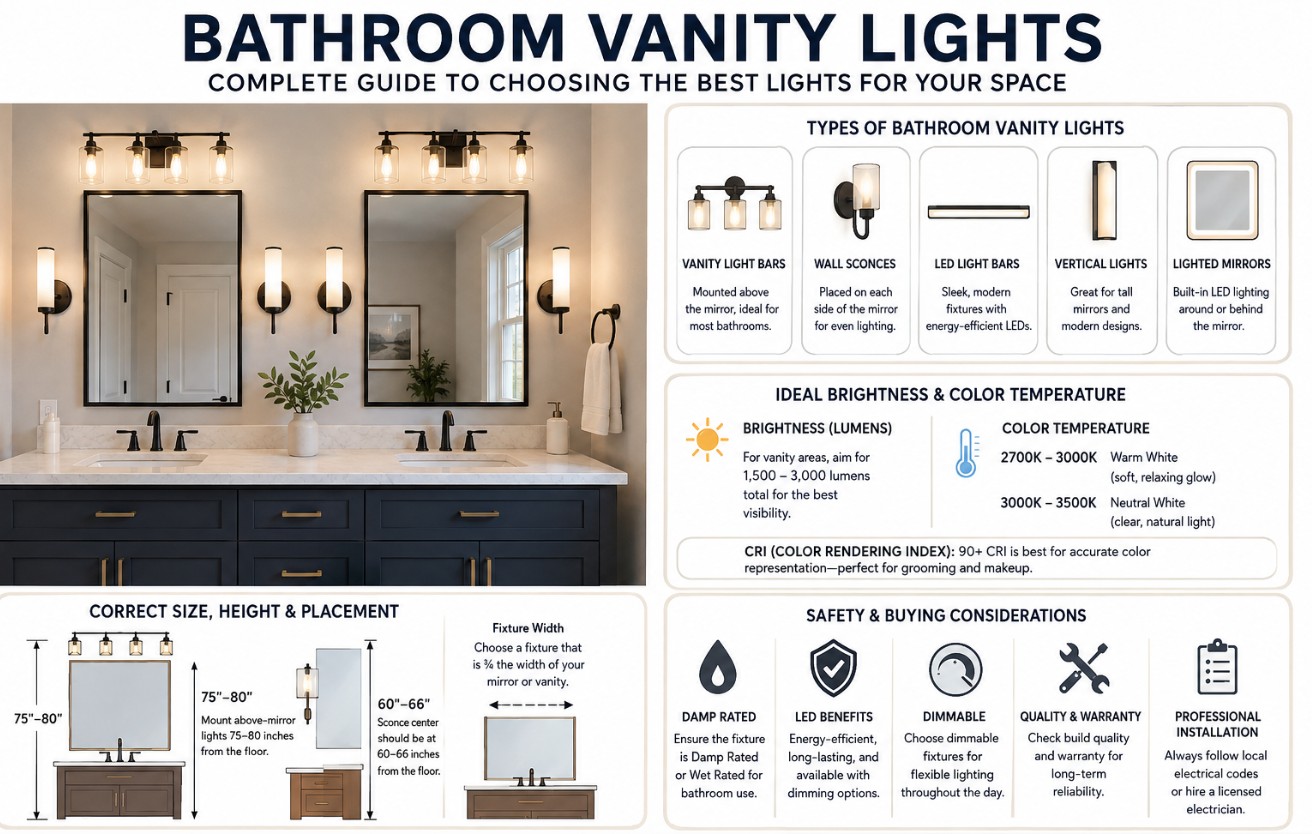
Choosing the right bathroom vanity lights can make a noticeable difference in how comfortable and functional your bathroom feels. Vanity lighting is used for everyday tasks such as shaving, applying makeup, styling hair, and checking your appearance, so it needs to do more than simply look attractive. A poorly positioned fixture can create shadows across your face, while overly bright or cool lighting can make the space feel harsh.
Modern bathroom lighting gives homeowners plenty of options, including wall sconces, multi-light vanity bars, integrated LED fixtures, vertical light bars, and illuminated mirrors. The right choice depends on your mirror size, available wall space, desired brightness, and overall bathroom design. Paying attention to light output, color temperature, fixture proportions, and moisture ratings can help you create a vanity area that works well every day.
How to Choose the Right Bathroom Vanity Lights
The best bathroom vanity lighting starts with the way you actually use the space. If the vanity is mainly used for quick morning routines, a well-positioned light bar above the mirror may provide enough illumination. If you regularly apply makeup, shave, or perform detailed grooming, side-mounted sconces are often the better option because they distribute light more evenly across the face.
You should also consider the size of the vanity and mirror before selecting a fixture. A small powder room may only need one compact light or two narrow sconces, while a large double vanity can benefit from multiple fixtures. The goal is to create balanced light without overwhelming the mirror or making the wall look crowded. Good vanity lighting should feel proportional to the room rather than simply being as bright as possible.
Style matters too, but function should come first. Matte black fixtures work well in modern or industrial bathrooms, while brushed nickel, chrome, brass, and bronze can suit traditional or transitional spaces. Frosted or opal glass shades are particularly useful because they soften glare and spread light more evenly. Clear glass can look stylish, but exposed bulbs may feel too harsh when positioned close to eye level.
Best Types of Bathroom Vanity Lights for Different Spaces
Wall sconces are among the most effective options for a vanity because they can be installed on both sides of the mirror. This creates balanced illumination from left and right, helping reduce the strong shadows often caused by overhead lighting. In bathrooms where grooming accuracy matters, this arrangement is usually more practical than relying on one ceiling fixture.
Vanity light bars are another popular choice, especially when there is limited space beside the mirror. These fixtures are mounted above the mirror and are available with two, three, four, or more light sources. They are simple to install when an electrical box is already centered over the vanity, and they work well in many standard bathrooms.
Integrated LED bars have become increasingly common in modern spaces. They have a slimmer appearance than traditional bulb-based fixtures and can provide even light across the mirror. Some models also include dimming and adjustable color temperature settings, which can be useful when you want bright task lighting in the morning and softer lighting at night.
Lighted mirrors are another practical solution, particularly in minimalist bathrooms or rooms with limited wall space. LEDs are built directly into or around the mirror, producing a clean appearance and reducing the need for separate fixtures. However, they still work best when the bathroom has additional ambient lighting, such as recessed ceiling lights or a central fixture.
Ideal Brightness, Color Temperature, and CRI
Brightness is one of the most important factors when choosing bathroom vanity lights, but it is better to compare lumens rather than watts. Watts measure how much electricity a bulb consumes, while lumens measure the amount of visible light it produces. This distinction is especially important with LEDs, which can produce high light output while using relatively little power.
For more information on comparing LED efficiency and light output, the U.S. Department of Energy provides useful guidance on LED lighting performance. Rather than choosing a fixture based only on wattage, check the total lumen output and consider whether the rest of the bathroom already has ambient lighting.
Color temperature also affects how the vanity area looks and feels. For most residential bathrooms, 2700K to 3000K creates a warm, comfortable appearance. Around 3000K to 3500K can provide a slightly clearer, more neutral light that works well for grooming. Very cool lighting above 5000K may feel too clinical for many home bathrooms.
Another useful specification is CRI, or Color Rendering Index. A higher CRI means the light shows colors more accurately. This matters when applying makeup, evaluating skin tone, or matching clothing. For vanity lighting, 90+ CRI is a strong choice because it provides more natural-looking color than many lower-quality LEDs.
Correct Vanity Light Size, Height, and Placement
Fixture size should be visually balanced with the mirror and vanity. For an above-mirror light, a practical approach is to choose a fixture that is slightly narrower than the mirror or vanity. A light that extends far beyond the mirror can look oversized, while a fixture that is too small may leave the outer edges of the vanity poorly illuminated.
A common design guideline is to choose an above-mirror fixture that is roughly three-quarters of the mirror width. This is not a strict building rule, but it is a useful starting point. For example, a 36-inch mirror often pairs well with a fixture around 27 inches wide. The exact size will depend on the fixture design, shade width, and surrounding wall space.
Placement is equally important. Above-mirror lights are often installed around 75 to 80 inches from the finished floor, depending on the mirror height and ceiling. Side sconces are commonly positioned with their centers around 60 to 66 inches above the floor, which places the light near eye level for many users.
When using two sconces, keep them symmetrical and positioned far enough apart to frame the mirror naturally. The objective is to direct light across the face rather than from directly overhead. If household members vary significantly in height, placement should be chosen as a practical compromise rather than following a single number rigidly.
Safety Ratings, LED Features, and Buying Considerations
Bathrooms are humid spaces, so moisture ratings should never be ignored. A standard decorative wall light is not automatically suitable for bathroom use. Vanity fixtures should generally be rated for damp locations. Which means they are designed to handle humidity and moisture in the air.
If a fixture is installed where it may be directly exposed to water. Such as near a shower or tub, a wet-location rating may be required. Always follow the manufacturer’s installation instructions and local electrical requirements. Hardwired lighting should also be installed correctly in an appropriate electrical box, and professional installation is advisable when wiring needs to be moved or added.
When comparing LED bathroom vanity lights, check whether the fixture uses replaceable bulbs or integrated LEDs. Replaceable bulbs are easier to change later, while integrated LEDs often offer a cleaner design and long service life. With integrated fixtures, look at the warranty, rated lifespan, CRI, lumen output, color temperature, and whether the driver or LED module can be serviced.
Dimming is another useful feature. Bright light is helpful for morning grooming and cleaning, while lower light levels are more comfortable for nighttime use. If you want a dimmable fixture, make sure the LED fixture or bulbs are compatible with the dimmer switch. Selectable color temperature can also be valuable because it allows you to choose a warmer or cooler setting after installation.
Conclusion
The best bathroom vanity lights combine good placement, comfortable brightness, accurate color rendering, and a fixture size that suits the mirror and vanity. Side sconces are excellent for reducing facial shadows, while above-mirror bars remain practical for bathrooms with limited wall space. LED fixtures, lighted mirrors, and dimmable options can add flexibility without sacrificing style.
Before buying, pay attention to lumens, color temperature, CRI, moisture ratings, fixture dimensions, and installation requirements. A well-chosen vanity light should make everyday grooming easier while also improving the overall appearance of the bathroom.
FAQs
What color temperature is best for bathroom vanity lights?
For most bathrooms, 3000K is a strong all-around choice. It provides a warm-neutral appearance that works well for both grooming and general use.
Should vanity lights point up or down?
Downward-facing lights provide more direct task lighting, while upward-facing lights create softer ambient illumination. For grooming, downward or face-directed light is generally more useful.
Are LED vanity lights better than traditional bulbs?
LEDs are usually more energy-efficient and longer-lasting. They also offer useful features such as dimming, high CRI, and selectable color temperature.
Do bathroom vanity lights need to be damp-rated?
Yes, damp-rated fixtures are generally recommended for normal bathroom vanity areas because bathrooms are exposed to humidity and condensation.
