
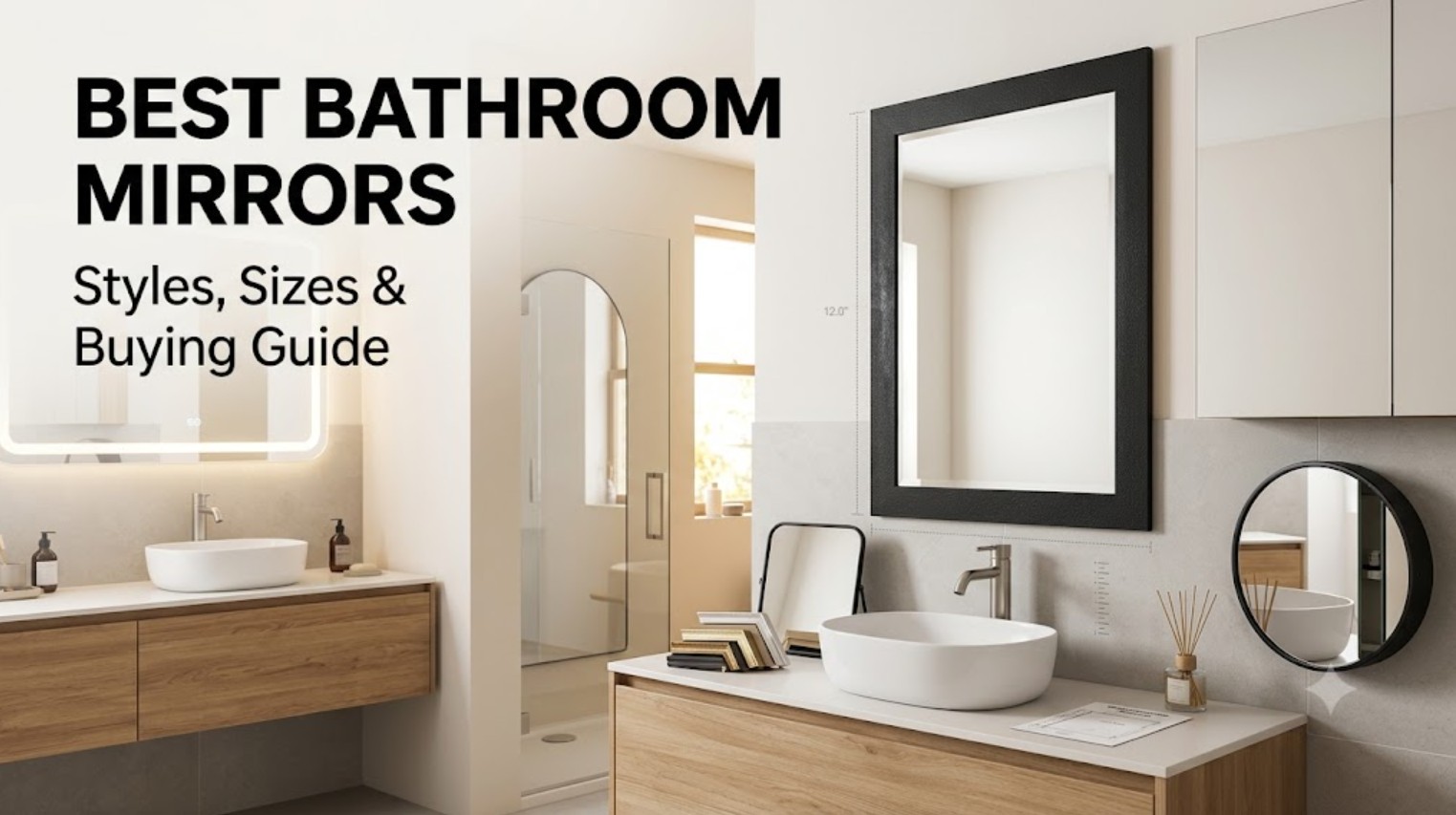
Bathroom mirrors do much more than provide a reflection. The right mirror can improve task lighting, make a compact room feel larger, add useful storage, and create a clear focal point above the vanity. A poorly chosen model, however, may sit too high, look out of proportion, create facial shadows, or struggle in a humid environment.
The best bathroom mirrors depend on the vanity size, available wall space, lighting conditions, and how the room is used. A simple framed mirror may be enough for a powder room, while a shared primary bathroom may benefit from a wide illuminated mirror or two separate mirrors above a double vanity. Comparing practical features before focusing on appearance helps ensure the mirror remains useful for years.
Compare the Main Types of Bathroom Mirrors
Framed and frameless mirrors are the most common choices. A framed mirror adds visual definition and can coordinate with faucets, cabinet hardware, lighting, and the vanity finish. Metal and moisture-resistant composite frames generally perform well in humid bathrooms. Natural wood can also work, but it should be properly sealed to reduce the risk of swelling, staining, or warping.
Frameless mirrors create a cleaner and more open appearance. They provide a larger uninterrupted reflective area and suit modern, minimalist, and transitional bathrooms. Their polished or beveled edges can look elegant, although the mounting hardware and wall finish may remain more visible than they would with a framed design.
A mirrored medicine cabinet combines reflection with concealed storage. This is particularly useful in small bathrooms where countertop space is limited. Surface-mounted cabinets are easier to install, while recessed cabinets sit more neatly inside the wall. A recessed installation requires enough wall depth and a cavity free from pipes, wiring, vents, and structural framing.
LED and backlit mirrors add integrated illumination. Front-lit models direct more light toward the face, making them useful for shaving, makeup, skincare, and grooming. Backlit mirrors create softer ambient light around the edges but may still require separate task lighting. Pivoting mirrors, magnifying mirrors, and custom wall-to-wall designs are more specialized options for accessibility, detailed grooming, or unusual room layouts.
Choose the Right Mirror Size and Shape
Mirror size should relate to the vanity rather than the entire wall. A common approach is to choose a mirror that is equal to or slightly narrower than the vanity. This creates balanced proportions and leaves space for sconces or decorative wall finishes. An oversized mirror can also work, especially in a narrow bathroom where additional reflection makes the room feel more open.
Measure the vanity width, backsplash height, faucet height, ceiling clearance, and positions of nearby outlets or light fixtures before ordering. Use painter’s tape to mark the proposed mirror outline on the wall. This simple step helps reveal whether the mirror will feel too small, too wide, or too high when viewed from the doorway and from the standing position at the sink.
For a double vanity, homeowners usually choose one wide mirror or two individual mirrors. A single mirror reflects more light and visually connects the entire vanity. Two separate mirrors define each sink and may leave space for a central light fixture or storage cabinet. The mirror positions should align with the sinks and faucets rather than only with the cabinet doors below.
Shape also affects the room’s character. Rectangular mirrors provide the most usable reflection and work with nearly every design style. Round and oval mirrors soften bathrooms dominated by straight lines. Arched mirrors combine a practical lower section with a curved top, while asymmetrical shapes create a decorative focal point. Unusual shapes may offer less viewing area, so they are often better suited to powder rooms than busy family bathrooms.
Understand Lighting, Anti-Fog, and Smart Features
Bathroom lighting should illuminate the face evenly. A single ceiling light or overhead fixture may create shadows under the eyes, nose, and chin. Side sconces placed near eye level usually provide more balanced grooming light. An illuminated mirror can improve visibility, but its brightness and light distribution should be reviewed before it replaces separate vanity lighting.
When comparing lighted bathroom mirrors, check the lumen output, dimming controls, colour temperature, and Color Rendering Index. A CRI of 90 or higher can provide more accurate colour representation, which is useful for makeup and skincare. Adjustable colour temperature allows users to switch between warmer evening light and cooler task lighting.
Anti-fog mirrors contain a heating pad behind part of the glass. The heated section helps reduce condensation after a hot shower, allowing the mirror to remain usable. Check whether the heating element covers the entire mirror or only the central area. A defogger improves convenience but does not replace proper bathroom ventilation.
Smart models may include touch controls, clocks, Bluetooth speakers, motion sensors, charging ports, or app connectivity. These features can be useful, but they add cost and electronic components that may eventually require repair. Before buying, confirm whether the mirror works without Wi-Fi, whether replacement drivers are available, and how long the manufacturer covers the lighting and controls.
For accessible bathrooms, mirror placement should serve both standing and seated users. The 2010 ADA Standards for Accessible Design state that mirrors above lavatories in covered facilities should have the bottom edge of the reflecting surface no higher than 40 inches above the floor. These standards do not automatically apply to every private home, but they provide useful guidance for universal design.
Match the Mirror With Your Vanity and Bathroom Style
The mirror should relate visually to the vanity, faucet, lighting, and hardware without matching every finish exactly. A thin black or brushed-metal frame can provide contrast above a light vanity. Warm metallic frames pair well with wood cabinetry, while frameless mirrors suit simple stone or solid-surface countertops.
Consider the visual weight of the fixtures. A large vanity with substantial cabinetry may look unbalanced beneath a very small mirror. A compact pedestal sink may feel crowded under a wide, heavy frame. The mirror should support the composition rather than compete with the sink, lighting, and backsplash.
In a small bathroom, a larger reflective surface can distribute light and create a sense of depth. A recessed medicine cabinet is also practical because it adds storage without using valuable counter space. In a large primary bathroom, a custom-width mirror or two coordinated mirrors can create a more intentional design.
Current bathroom design favours rounded rectangles, arches, slim frames, integrated lighting, and warm metallic finishes. These styles can look contemporary without becoming overly decorative. However, trends should remain secondary to reflection quality, proportions, lighting, and ease of maintenance.
Consider Installation, Safety, and Maintenance
Large bathroom mirrors can be surprisingly heavy. The mounting system must be rated for the mirror’s full weight and suitable for the wall construction. Common methods include French cleats, metal rails, mirror clips, brackets, and manufacturer-supplied hanging systems. Heavy mirrors may require anchoring into wall studs or additional backing.
Professional installation is advisable for oversized glass, tiled walls, recessed medicine cabinets, and hardwired LED mirrors. Drilling into tile carries a risk of cracking, while recessed cabinets may require framing changes. Electrical connections must follow local codes and the product manufacturer’s instructions.
Moisture can damage reflective backing and cause dark edges or cloudy spots, a process often called desilvering. To reduce this risk, avoid spraying cleaner directly onto the glass. Apply it to a soft microfiber cloth instead, then wipe the mirror and dry the edges. Abrasive pads and harsh chemicals may damage coatings, frames, and electronic components.
Check the mounting hardware periodically and keep the bathroom properly ventilated. Wooden frames should be inspected for swelling, while metal frames should be checked for corrosion. If an LED mirror begins flickering, the issue may involve wiring, a dimmer, or the electronic driver rather than the glass itself.
Conclusion
The best bathroom mirrors combine accurate reflection, suitable proportions, effective lighting, and safe installation. Framed and frameless models work well in most bathrooms, while medicine cabinets add storage and LED mirrors improve task lighting.
Measure the vanity and wall carefully before buying. Consider who uses the room, how much storage is needed, and whether features such as anti-fog heating or adjustable lighting will provide genuine value. A well-chosen mirror should improve both the appearance and everyday function of the bathroom.
Frequently Asked Questions
What size mirror should I use over a bathroom vanity?
Choose a mirror approximately equal to or slightly narrower than the vanity. Leave enough space for lighting, outlets, and surrounding wall finishes.
Are LED bathroom mirrors worth buying?
They can be worthwhile when they provide adequate brightness, a high CRI, dimming controls, and a reliable warranty. Backlighting alone may not be enough for detailed grooming.
Is one large mirror better than two mirrors?
One large mirror reflects more light and makes the room feel wider. Two mirrors can define separate sinks and provide a more structured appearance.
How do I stop a bathroom mirror from fogging?
Improve ventilation, run the exhaust fan during and after showers, or choose a mirror with a built-in heating pad or defogger.
